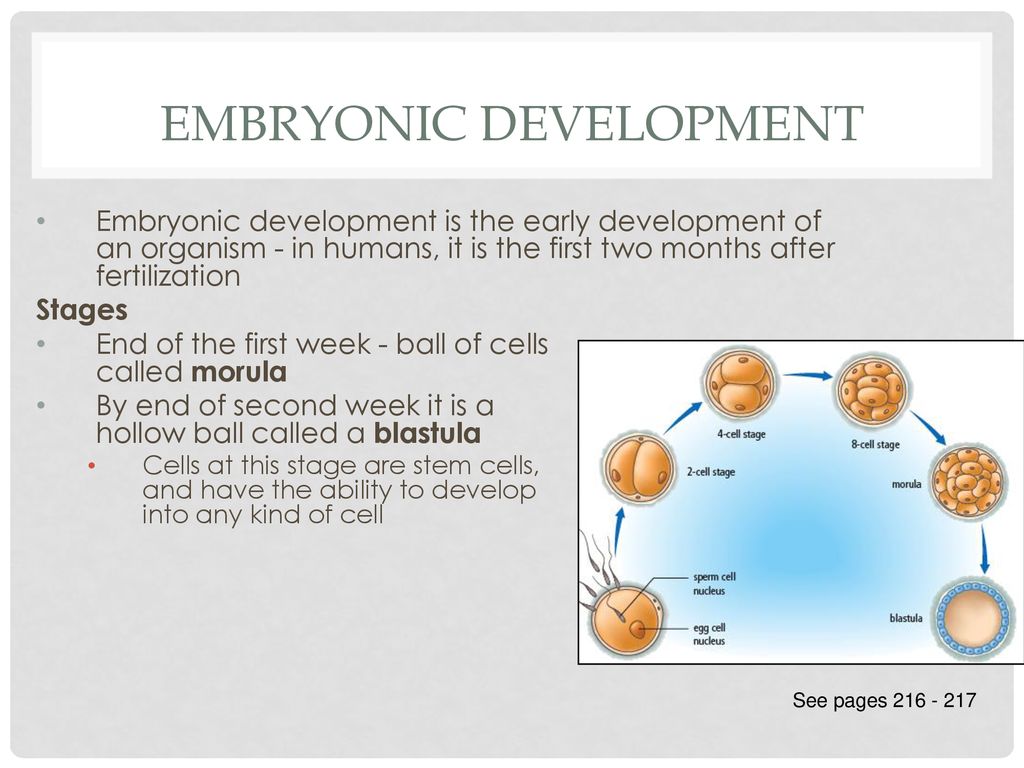
A sketch of the early stages of mammalian embryonic development Biology Diagrams 1. Introduction. Animal embryonic development is well-orchestrated in time and in space. Being composed of manifold diverse cellular and biochemical events, developmental transitions such as oocyte-to-embryo transition and maternal-to-zygotic transition are regulated by multiple, sometimes independent signals [1,2,3], which add up to precise and robust spatiotemporal regulation. The role of the cell cycle as an inhibitor of the late stages of cellular differentiation is well known, but in early embryonic development its role is mysterious. Normally, embryonic stem (ES) cells proliferate quickly during differentiation and do

This could be achieved by combining studies on in vitro cultured human embryos (Xiang et al., 2019) with in vivo and in vitro cultured monkey embryos (Nakamura et al., 2016; Niu et al., 2019; Ma et al., 2019) and the development of new stem cell models of the human embryo comprising both embryonic and extra-embryonic stem cells, as previously Early embryonic development is characterized by a plethora of very complex and simultaneously operating processes, which are constantly changing cellular morphology and behaviour. Regulation of the cell cycle in early mammalian embryos and its clinical implications Int J Dev Biol. 2019;63(3-4-5):113-122. doi: 10.1387/ijdb.180400ma. The preimplantation development stage of mammalian embryogenesis consists of a series of highly conserved, regulated, and predictable cell divisions. This process is essential to allow the rapid expansion and differentiation of a single-cell zygote into a multicellular blastocyst containing cells of …

Mechanisms of human embryo development: from cell fate to tissue shape ... Biology Diagrams
Proper control of embryonic development requires that the correct number of cells assume the right fate and position. At the heart of such process are mechanisms controlling cell proliferation and positioning. Recent advancements in imaging and computational methods have begun to reveal how the cell cycle is controlled during development and Human embryonic development or human embryogenesis is the development and formation of the human embryo.It is characterised by the processes of cell division and cellular differentiation of the embryo that occurs during the early stages of development. In biological terms, the development of the human body entails growth from a one-celled zygote to an adult human being. Understanding the mechanisms of embryonic cell cycles is a central goal of developmental biology, as the regulation of the cell cycle must be closely coordinated with other events during early embryogenesis. Quantitative imaging approaches have recently begun to reveal how the cell cycle oscillator …